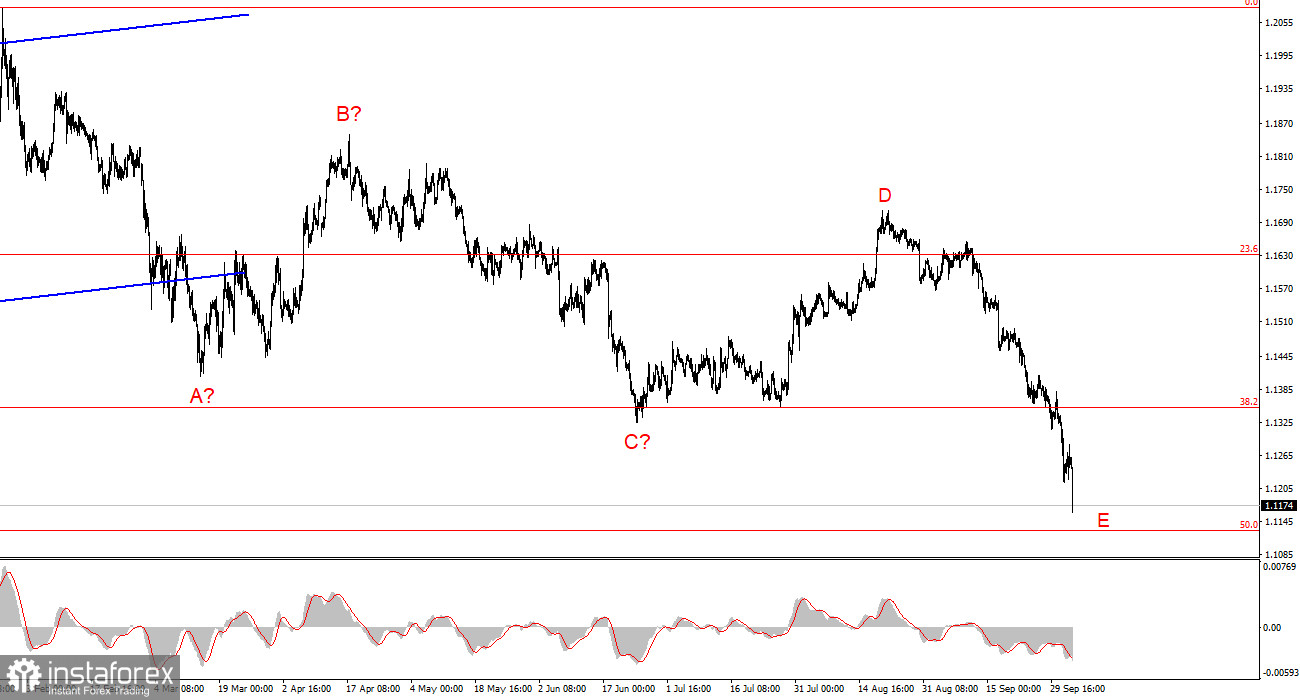
The wave structure of the four-hour EUR/USD chart is becoming more complex. There is still no question of canceling the upward section of the trend (lower chart), which began in January last year. On the contrary, we saw a complete A-B-C corrective structure, which may have been completed. However, recent events related to the Federal Reserve and its policy have once again affected the current wave structure, making it more complex. I would like to remind you that the news background and wave structure often conflict with each other, which makes it necessary to adjust the wave count.
The wave structure has now transformed into a more complex pattern. Wave C has taken a three-wave form, while the next wave is identified as wave D. The entire section of the trend that began on January 27 may take a five-wave corrective form, A-B-C-D-E. If this assumption is correct, wave D has been completed, and on August 21, EUR/USD entered the phase of forming wave E, whose low should be below the low of wave C at 1.1325. The pair is only a short distance from this level, and below it, the assumed wave E may complete its formation at any time.
Market participants continue to focus on the Federal Reserve.
The EUR/USD pair rose by 10 basis points on Friday. This is another case where it is difficult to determine how to interpret such a movement. The euro failed to strengthen its position despite another opportunity to do so, while the market once again ignored information that could have put pressure on the US dollar. Much has already been said about the Nonfarm Payrolls report and the unemployment rate. Some experts considered the figures "not as bad" as the official data suggested. Others noted that the outlook for the Federal Reserve's monetary policy had not changed following the release of these reports, and therefore demand for the US currency did not decline. In my view, this is another attempt to explain an unexpected market reaction. The September Nonfarm Payrolls report can reasonably be described as very weak, while the August figure, which had led Federal Reserve policymakers to conclude that the labor market was in good condition (and to raise the interest rate), was revised downward. The unemployment rate increased when no such rise was expected. What positive aspects can therefore be found in these data?
However, while focusing on the US labor market reports, traders completely overlooked inflation in the European Union, which was also released on Friday and should likewise have supported the euro. The Consumer Price Index rose from 3.2% year-on-year to 3.8%, while market participants had expected an increase only to 3.6%. Consequently, the ECB has new grounds for tightening monetary policy, as the previous two rounds of tightening failed to stop the acceleration in price growth in the European Union. By the end of the year, the European regulator could carry out a third and even a fourth round of rate hikes, but the market is showing little reaction to this possibility. Monday began with another sharp decline, as geopolitical tensions in the Middle East intensified again.
General Conclusions
Based on the EUR/USD analysis, I conclude that the pair remains within the global corrective section of the trend, A-B-C-D-E. If this assumption is correct, the decline in prices will continue toward targets below the low of wave C at 1.1325. I considered this scenario to be an alternative one, and if not for the Federal Reserve meeting, it would have remained a reserve scenario. However, the Federal Reserve delivered an unexpected outcome, leaving the market with few alternatives other than another wave of US dollar buying. Nevertheless, these purchases have continued for several weeks, even though there are no new fundamental factors supporting the dollar. I would not open short positions against such a news background and would instead prepare for a reversal.
On the higher time frame, a downward section of the trend can be seen, taking the form of A-B-C-D-E. Consequently, EUR/USD may continue declining below the low of wave C, while the internal wave structure of wave E may take a five-wave impulsive form.
Main Principles of My Analysis:
- Wave structures should be simple and clear. Complex structures are difficult to trade and often require adjustments.
- If there is no confidence in what is happening in the market, it is better not to enter the market.
- There can never be 100% certainty about the direction of price movement. Do not forget to use protective Stop Loss orders.
- Wave analysis can be combined with other types of analysis and trading strategies.